What is acupuncture?
Most people’s first experience of having a needle inserted into their body is during their vaccination or when they are drawing blood for medical examinations. As such they often associate pain with the sight of needles. This is understandable.
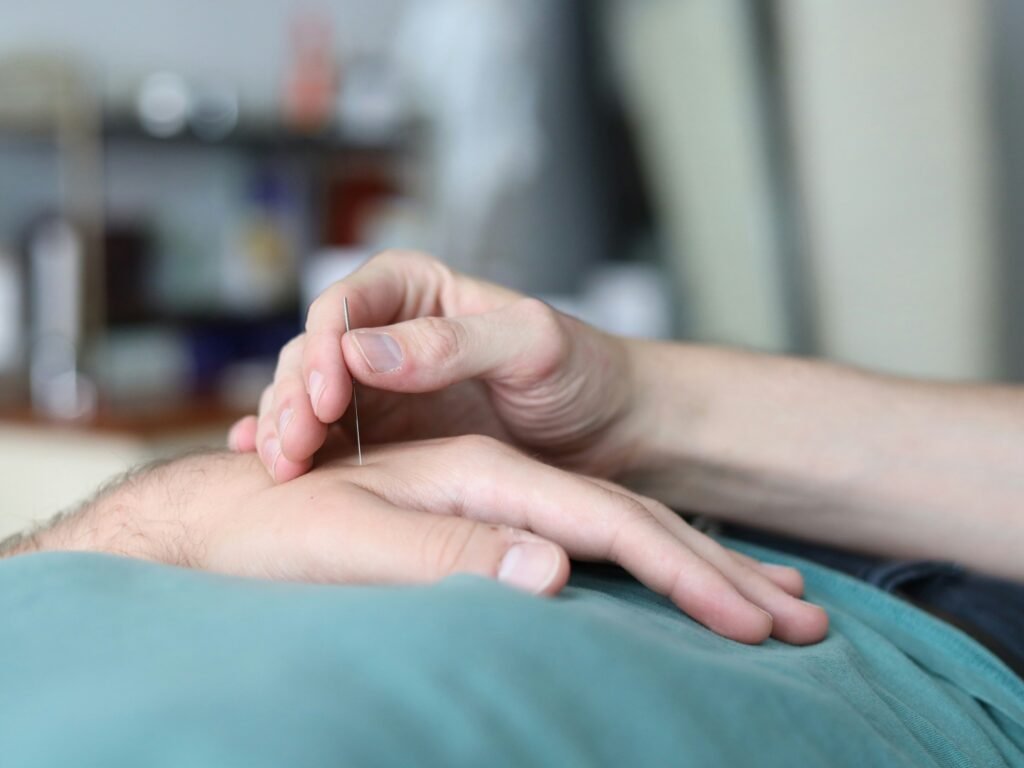
Acupuncture uses solid needles that is about the same thickness as a human hair. It is much thinner as compared to syringe needles used to draw blood (which can sometime be 10 times wider). As such, most of the time, my patients don’t even feel any sensation after I have completed inserting all the needles for the session.
So what can this tiny needle do?
In TCM, painful conditions are often due to “气滞血瘀” qi (energy) stagnation (blockage) leading to blood stasis. Be it a lower back pain or a sprain, the flow of energy is blocked and blood starts to pools at the point of blockage, resulting in pain.
The acupuncture needles relieves the blockage through redirecting the flow of qi along the energy pathways known as meridians, allowing the blood to flow smoothly and your body to heal naturally.
Many patients can feel the release in tension at the pain points right after the session while the body continues to heal over the next few days.
Modern western medical research 1 also show that acupuncture helps relieve pain through:
- Local Physiological Response: stimulation of local skin, fascia and muscle tissues
- Inhibition of Pain Signals: stimulation of peripheral sensory nerves that travel to the spinal cord and supraspinal levels, suppressing pain signals.
- Release of Endogenous Opioids & Biochemicals: triggers both peripheral/ central release of natural pain-relieving substances in our bodies (endogenous opioids and other biochemical mediators).
- Anti-Inflammatory & Autonomic Regulation: reduces systemic and local inflammation
What conditions can acupuncture treat?
Acupuncture is commonly used in Singapore to treat:
- Acute Pain: Muscle sprain, Stiff neck
- Chronic pain: Low back pain, osteoarthritis, migraines, and joint stiffness
- Rehabilitation: Post stroke or post surgery
Beside painful conditions, many may be surprised to know that acupuncture can also treat other conditions such as:
- Metabolic disorder: diabetes, obesity
- Gastrointestinal issues: Irritable Bowel Syndrome (IBS), chronic constipation and abdominal bloating.
- Mental health and neurological support: Mood and stress, sleeping disorders
- Reproductive and hormonal health: Menstrual pain, fertility treatment
什么是针灸?
大多数人初次体验针头刺入身体,通常是在接种疫苗或因医疗检查而抽血的时候。因此,他们往往一看到针头就会联想到疼痛。这种反应是可以理解的。
针灸使用的是实心针,其粗细与人的头发丝相当。这比用于抽血的注射针头要细得多(后者有时甚至比针灸针粗十倍)。因此,大多数情况下,当我在治疗过程中将所有针都扎好后,患者甚至感觉不到任何痛感或不适。
这么细小的针能做什么?
在中医理论中,疼痛症状往往源于“气滞血瘀”——即气(能量)的停滞或阻滞引发了血瘀。无论是腰痛还是扭伤,当气流受阻时,血液便会在受阻部位淤积,进而引发疼痛。
针灸通过引导“气”沿着被称为“经络”的能量通道流动来疏通阻塞,从而促进血液顺畅运行,并让身体实现自然自愈。
许多患者在治疗结束后,能立即感受到疼痛部位的紧张感得到缓解,而身体也会在随后的几天里继续自我修复。
现代西方医学研究也表明,针灸通过以下方式帮助缓解疼痛:
- 局部生理反应:刺激局部皮肤、筋膜及肌肉组织。
- 疼痛信号抑制:刺激通往脊髓及脊髓以上中枢的周围感觉神经,从而抑制疼痛信号。
- 内源性阿片类物质及生化物质的释放:触发体内天然镇痛物质(内源性阿片类物质及其他生化介质)的外周及中枢释放。
- 抗炎与自主神经调节:减轻全身性及局部炎症
针灸可以治疗哪些病症?
在新加坡,针灸常用于治疗:
- 急性疼痛:肌肉扭伤、落枕
- 慢性疼痛:腰痛、骨关节炎、偏头痛和关节僵硬
- 康复:中风后或术后
除了疼痛性病症外,许多人可能会惊讶地发现,针灸还可以治疗其他病症,例如:
- 代谢紊乱:糖尿病、肥胖症
- 胃肠道问题:肠易激综合征(IBS)、慢性便秘和腹胀。
- 心理健康与神经系统支持:情绪与压力、睡眠障碍
- 生殖与荷尔蒙健康:痛经、生育治疗